Call first
Call (936) 873-7200 to talk about the roof. Phone is the contact channel for this business.
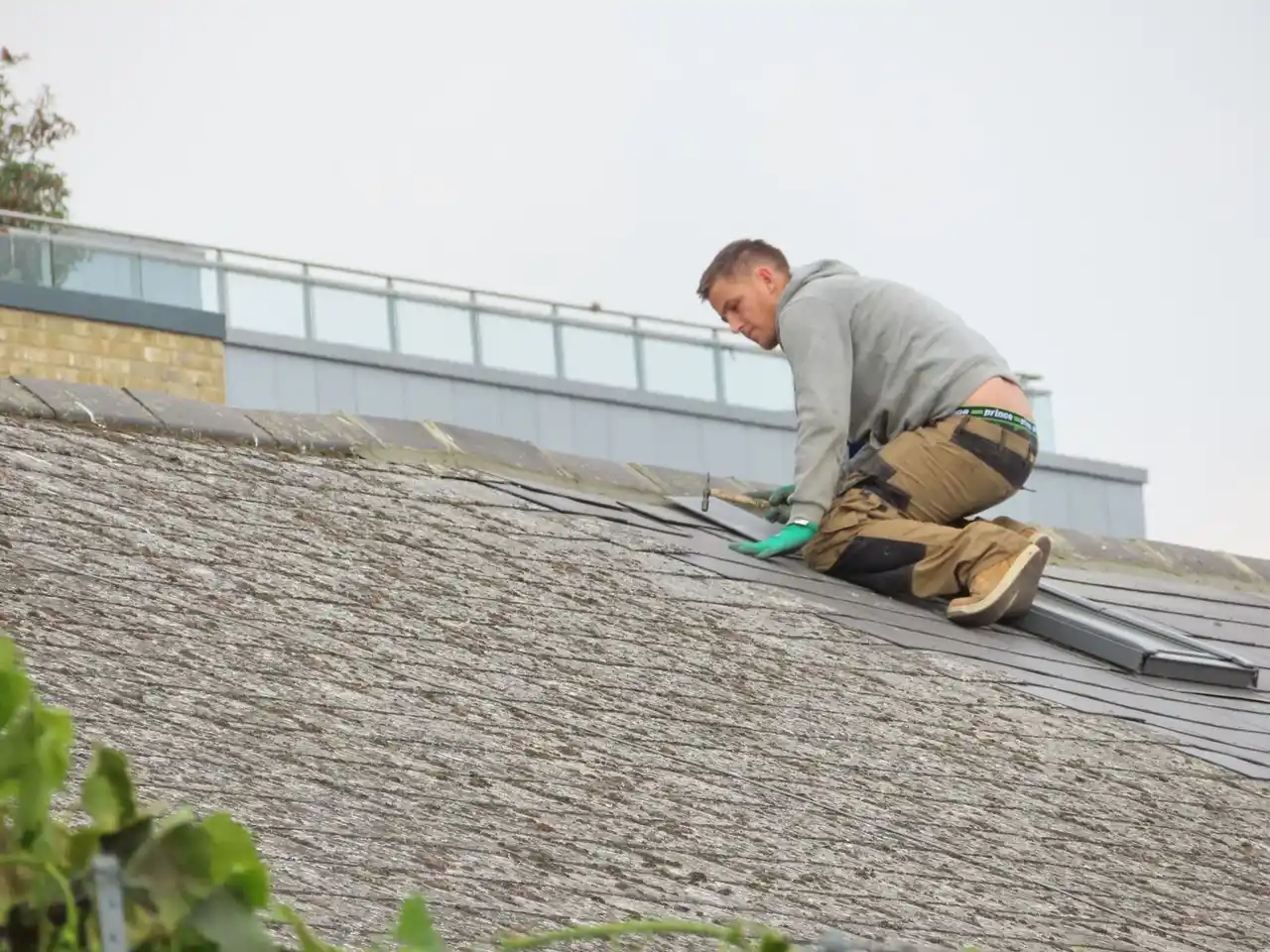
Roofing in the Energy Corridor, Houston, starts with one question: which side of the dam is the house on? The Energy Corridor is not a Super Neighborhood — it is an energy-industry business district overlapping west Memorial (SN 16) and Eldridge / West Oaks (SN 17), running parallel to I-10 between Highway 6 and Kirkwood Road. Homes upstream, inside or beside the Addicks and Barker basins can flood when the pool rises behind the dams; homes downstream flood when released water pushes Buffalo Bayou out of its banks. That dual mechanism, pool and release, is the Corridor’s distinguishing flood fact, and it has to be stated separately.
Call (936) 873-7200 to talk about the roof. Phone is the contact channel for this business.
46 Google reviews: 42 five-star and 4 four-star.
A City of Houston Residential Roofing Permit is required for a re-roof or overlay.
Based at 5507 Lyons Ave, Houston, TX 77020, in Greater Fifth Ward.
Roofing in the Energy Corridor, Houston, starts with one question: which side of the dam is the house on? The Energy Corridor is not a Super Neighborhood — it is an energy-industry business district overlapping west Memorial (SN 16) and Eldridge / West Oaks (SN 17), running parallel to I-10 between Highway 6 and Kirkwood Road. Homes upstream, inside or beside the Addicks and Barker basins can flood when the pool rises behind the dams; homes downstream flood when released water pushes Buffalo Bayou out of its banks. That dual mechanism, pool and release, is the Corridor’s distinguishing flood fact, and it has to be stated separately.
The one sentence: No other Houston roofing market is split by a dam: two houses a mile apart can flood by opposite mechanisms — one because the pool rose behind it, the other because the water was released in front of it.
The Corridor itself is offices, not houses — more than 300 companies employing 94,000 people, with BP America headquartered at Westlake Park in Memorial, and the district stretching about 7 miles along I-10 from Kirkwood Road to just west of Barker Cypress Road. The residential market is the subdivisions around it: west Memorial, Eldridge / West Oaks 1970s–90s subdivisions, townhomes and apartments, and Addicks / Park Ten (SN 9) at the reservoir edge.
Not a Super Neighborhood — overlaps SN 16 Memorial and SN 17 Eldridge / West Oaks
Architectural shingle is dominant on the 1970s–90s brick ranches and two-storey traditional homes around the Corridor; flat TPO or modified bitumen on townhomes and on the Corridor’s own commercial buildings, as a commercial cross-sell rather than the residential lead; metal on newer builds.
Reservoir-pool rise behind Addicks and Barker, and release-driven Buffalo Bayou flooding downstream. In Harvey, Addicks peaked at 109.1 feet on 30 August 2017 and about 7,000 acres of private land upstream were deliberately submerged. The Eldridge Parkway corridor carries released-water exposure; the Barker Reservoir edge carries pool exposure. Check the address.
Subdivision HOAs, mandatory in most 1970s–90s plats, with architectural review of material and colour. Commercial properties have landlord and property-manager approval chains instead.
Roofing services for Energy Corridor homes, from the pitched and flat systems this neighbourhood actually has to the storm and insurance work Houston roofs need. Call (936) 873-7200 to talk through which one fits the roof you have.
Full re-roof with a City of Houston Residential Roofing Permit where one is required, deck inspection once the covering is off, and a written scope before work starts.
Targeted repairs to shingles, flashing, valleys and penetrations — and an honest call when a repair would only postpone a replacement.
Leak tracing to the actual entry point, which is often not above the stain: flashing, valleys, skylight curbs, parapets and drains.
A documented inspection of covering, deck, flashing, ventilation and drainage, with photos, so a homeowner can plan instead of guessing.
Post-storm inspection and documentation after derecho, hail and hurricane wind, with the damage recorded for the insurance file.
Hail assessment that matches the roof: bruised shingle, cracked tile or slate, dented copper, or a cracked flat membrane that has not leaked yet.
Help documenting damage, meeting the adjuster and understanding ACV versus RCV. We are not a public adjuster and we do not negotiate claims.
TPO, modified bitumen and built-up membranes for townhome flat sections, additions and low-slope roofs, with tapered insulation where the pitch is effectively zero.
Five steps, in order, with the approval step before the work step — because in Energy Corridor the most expensive mistake is starting before the second approval lands.
Call (936) 873-7200 and tell us what you are seeing — a stain, a missing shingle, a flat section that ponds, or a storm date. We ask which decade the house is from, because in Energy Corridor that decides the inspection.
We inspect the covering, the deck, the flashing, the ventilation and the drainage, and we photograph what we find. On flat sections we probe the deck for soft spots; on older homes we check the attic for rot that never shows inside.
Before any work is priced we check the review layer for the address — Subdivision HOAs, mandatory in most 1970s–90s plats, with architectural review of material and colour. Commercial properties have landlord and property-manager approval chains instead. — and whether a City of Houston Residential Roofing Permit is required. Approvals are filed before work starts, not after.
You get a written scope for the roof that is actually there, with the deck condition, the system and the approvals listed. Houston market ranges are quoted only as sourced ranges, never as this business’s prices.
Work follows the approved scope, and the job is finished with a final walkthrough and the City inspection where a permit applies.
These are the problems the research names for Energy Corridor — its housing stock, its flood mechanism and its review layer — not a generic Houston list.
Homes beside the Addicks and Barker basins flood when the pool rises behind the dams — a slow, deliberate submergence of private land, not a bayou overflowing its banks. The roof damage is prolonged wetting of decking and underlayment.
Homes along the Eldridge Parkway corridor and Buffalo Bayou flood when released water pushes the bayou out of its banks. The mechanism, the timing and the mitigation are all different from pool flooding.
Much of the 1970s–90s stock was re-roofed after Harvey in 2017–2019 and is now 7–9 years old, so the near-term market here is inspection, repair and hail work rather than first replacement.
The Corridor’s office buildings carry large flat roofs with wind-uplift exposure of their own. That is commercial work with landlord approval chains, not a residential shingle job.
The Energy Corridor runs generally parallel to I-10 between Highway 6 and Kirkwood Road, extending south of Buffalo Bayou along Eldridge Parkway, and the full district extends west into Greater Katy. It overlaps Super Neighborhood 16 (Memorial) and Super Neighborhood 17 (Eldridge / West Oaks).
The two dams that define the Corridor’s flood story: pool rise on one side, controlled release on the other.
The corridor of released-water and Buffalo Bayou exposure, running south of the bayou.
Home of BP America’s headquarters in Memorial, at the Corridor’s eastern end.
The Corridor’s spine, with the residential subdivisions — Nottingham Forest, Bear Creek Village and the Eldridge / West Oaks plats — sitting just off it.
Thomas Family Roofing is based at 5507 Lyons Ave, Houston, TX 77020. The neighbouring location pages below are the ones this page links to, because their roofs, flood mechanisms and review layers are the ones a Energy Corridor homeowner is most likely to be comparing against.
The roof that survived the rain but not the reservoir: Addicks and Barker releases.
The low-slope ranch that flooded three times: 2015, 2016 and 2017.
High-rise condo roofs beside 1920s bungalows along Greenway Plaza.
High-rise flat membranes and parapet ponding, not a shingle market.
There are no case studies on this page, because no project results for this business were supplied or verified. What an inspection here actually checks is below — and what it costs is a market question, not a quote: Angi Houston, updated 1 August 2026, reports a full roof replacement averaging $9,752, with most projects at $6,712–$13,123, and an average repair at $1,002. Those are Houston market ranges, not this business’s prices.
Shingles, tile, slate, metal or membrane — and, once the covering is off on a re-roof, the deck beneath it. On older roofs the underlayment and deck often fail before the covering does.
Chimneys, skylights, dormers, valleys, parapets and drains are where Houston roofs actually leak. Each one is checked as a detail, not as a square-footage line.
Attic ventilation on older homes, and drain and scupper sizing on flat sections. A roof that cannot breathe or cannot drain will fail again, whatever the covering.
Rated 4.9 out of 5 from 46 Google reviews — 42 five-star and 4 four-star. The five reviews below are the readable Google reviews for this business, quoted as short excerpts with the reviewer’s name, stars and relative date. The other 41 reviews are not readable from the public profile and are shown only in the 4.9 out of 46 aggregate.
From our first call with Thomas Family Roofing, it was clear they were focused on giving us a quality new roof and making the whole roofing process easy to understand. Miguel explained the scope of the roof replacement, the materials and shingle options…
We contacted Thomas Family Roofing for an estimate on repairs for our metal roof in Houston. Luis came out, inspected the roof in person, and explained clearly what needed attention, including a few details about flashing and panel areas that other roofers had missed.
I hired Thomas Family Roofing for a flat roof repair after hearing good things from friends and reading strong reviews. The whole experience was smooth and professional from start to finish. They also cleaned out the roof drains since they were clogged…
They replaced an old cracked skylight on the roof of my two-story home, and i was very pleased with the whole roofing process. From the first call back to the roof inspection, estimate, and final installation, everything was handled on time…
I had storm damage on my roof, and after the first insurance adjuster met with another roofing company, the claim was not approved for roof repair. My niece suggested i call Johnathan, and he came out, met with a different adjuster, and helped get the roof replacement approved.
Five steps, in order, with the approval step before the work step — because in Energy Corridor the most expensive mistake is starting before the second approval lands.
Call (936) 873-7200 and tell us what you are seeing — a stain, a missing shingle, a flat section that ponds, or a storm date. We ask which decade the house is from, because in Energy Corridor that decides the inspection.
We inspect the covering, the deck, the flashing, the ventilation and the drainage, and we photograph what we find. On flat sections we probe the deck for soft spots; on older homes we check the attic for rot that never shows inside.
Before any work is priced we check the review layer for the address — Subdivision HOAs, mandatory in most 1970s–90s plats, with architectural review of material and colour. Commercial properties have landlord and property-manager approval chains instead. — and whether a City of Houston Residential Roofing Permit is required. Approvals are filed before work starts, not after.
You get a written scope for the roof that is actually there, with the deck condition, the system and the approvals listed. Houston market ranges are quoted only as sourced ranges, never as this business’s prices.
Work follows the approved scope, and the job is finished with a final walkthrough and the City inspection where a permit applies.
Roofing is local work, and the next neighbourhood over often has a different roof system, flood mechanism and review layer. These are the neighbouring pages for Energy Corridor.
Five questions, in the order that matters for Energy Corridor. The answers should be specific to the address, not generic.
A City of Houston Residential Roofing Permit is required for a re-roof or overlay inside the city — plan review and inspection, a $33.56 admin fee, about 10 business days, valid 6 months, with roof covering of 100 sq ft or less in aggregate exempt. Ask who files it.
In Energy Corridor, the review layer is: Subdivision HOAs, mandatory in most 1970s–90s plats, with architectural review of material and colour. Commercial properties have landlord and property-manager approval chains instead. Ask for the approval to be filed before work starts.
No. Texas has no state roofing contractor licence. If a roofer shows you a licence number, ask what it actually is — Houston has only a voluntary contractor registration.
On a replacement-cost policy the insurer typically pays actual cash value first and releases recoverable depreciation only after the work is completed and documented. Waiving or absorbing a deductible is illegal in Texas, and a roofer may not act as a public adjuster.
Ask before work starts. On older and flood-affected roofs the deck is often the real job, and a quote that assumes sound decking is not a quote for the roof you have.
What can be verified about roofing in Houston, stated plainly. Anything that cannot be verified is not claimed on this page.
A Residential Roofing Permit is required for a re-roof or overlay inside the city: plan review and inspection, $33.56 admin fee, about 10 business days, valid 6 months, 100 sq ft aggregate exemption for roof covering.
Texas has no state roofing contractor licence. The Texas Department of Licensing and Regulation does not license roofers, and HB 3344 (2025), the bill that would have created one, died in committee on 8 May 2025.
Houston adopted the 2021 IBC and IRC by Ordinance No. 2023-907, effective January 2024, with Houston Amendments. Re-roofing follows the adopted code, not a national summary.
It is illegal for a contractor to waive, rebate or absorb a homeowner’s deductible under Texas Insurance Code Chapter 707 and Business & Commerce Code §27.02. Any offer to cover the deductible is a red flag.
A roofer may not act or advertise as a public adjuster under Insurance Code §4102.163. We document damage, meet the adjuster and help with paperwork; we do not negotiate the claim or guarantee approval.
Effective FEMA maps date to 2007 and the MAAPnext draft maps are not regulatory until about 2028. A flood zone is checked for the address, never assigned to a whole neighbourhood.
The windstorm catastrophe area covers Harris County only east of SH 146, inside La Porte, Morgan’s Point, Pasadena, Seabrook and Shoreacres. Most Houston homes carry wind and hail in a standard homeowners policy.
Thomas Family Roofing is rated 4.9 out of 5 from 46 Google reviews: 42 five-star and 4 four-star. No hours are published for this business, and none are claimed on this site.
No. The Energy Corridor is a business district, not one of the City’s 88 Super Neighborhoods. It overlaps Memorial (SN 16) and Eldridge / West Oaks (SN 17), and a location page must give those numbers rather than inventing one for the Corridor.
Pool flooding happens upstream, inside or beside the Addicks and Barker basins when the water level rises behind the dams — in Harvey, Addicks peaked at 109.1 feet on 30 August 2017. Release flooding happens downstream when released water pushes Buffalo Bayou out of its banks. A house can face one, the other, or neither, depending on which side of the dam it sits on.
There is no single zone. The Eldridge Parkway corridor carries released-water and Buffalo Bayou exposure; the Barker Reservoir edge carries pool exposure. Check the address parcel by parcel.
Angi Houston, updated 1 August 2026, reports a full roof replacement averaging $9,752, with most projects at $6,712–$13,123, and an average repair at $1,002. Those are Houston market ranges, not this business’s prices.
No. Texas has no state roofing contractor licence — the Texas Department of Licensing and Regulation does not license roofers, and the 2025 bill that would have created one died in committee. Houston has only a voluntary contractor registration.
Not seeing your question? Call (936) 873-7200 and ask the local team.
Ask the local teamCall (936) 873-7200 or use the form and we will get an inspector to your roof. Tell us what you are seeing and we will tell you what it takes to fix it. Phone is the contact channel for this business; no email address is published.